 Natalia Bonner of Piece N Quilt blog shares how she made this Funky Wonderland quilt. Get the how-to.
{Image: Piece N Quilt}
Technorati Tags: piece, tutorial, quilting, applique, flowers, Funky Wonderland, Natalia Bonner, quilt
Independent craft blog since 2007
Natalia Bonner of Piece N Quilt blog shares how she made this Funky Wonderland quilt. Get the how-to.
{Image: Piece N Quilt}
Technorati Tags: piece, tutorial, quilting, applique, flowers, Funky Wonderland, Natalia Bonner, quilt
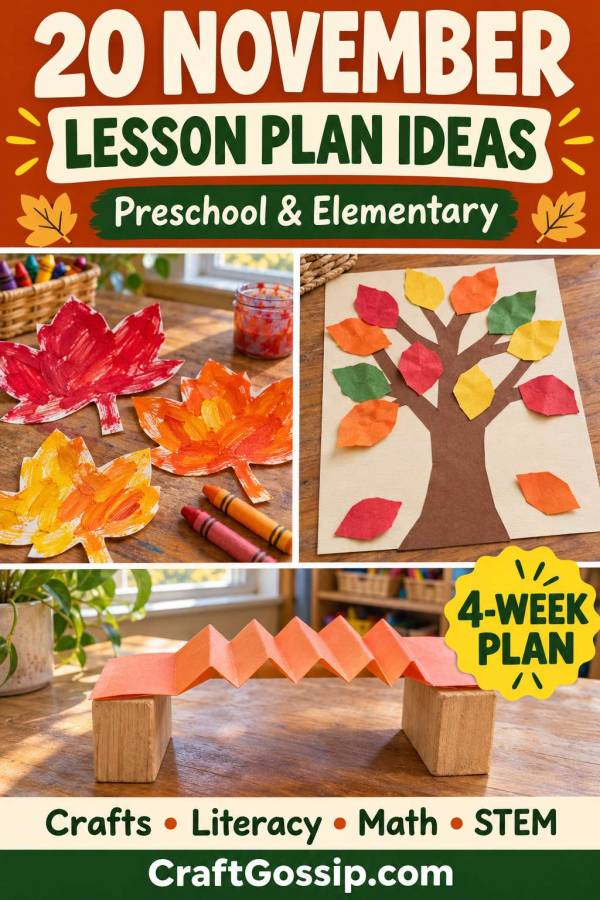
November has a habit of sneaking up on us. One minute we’re clearing away the Halloween crafts, and the next we’re looking for meaningful learning activities that will fit around holidays, school events and a timetable that seems to shrink by the day.
If you’re searching for November lesson plan ideas, I’d start with a handful of flexible themes: seasonal changes, gratitude, food and farming, community, and simple engineering challenges. These give you plenty of room for reading, writing, math, science and hands-on making without needing an entirely new basket of supplies every Monday.
And no, every activity doesn’t need a turkey attached to it. November offers plenty to explore whether your class celebrates Thanksgiving or you’re teaching somewhere that November means spring flowers and warmer afternoons.
Below you’ll find 20 practical activities for preschool, kindergarten and early elementary, followed by a four-week planning guide and a sample lesson you can adapt.
Start with the skill, then choose the seasonal activity.
If children are learning to count objects accurately, paper leaves can become counting materials. If they’re practising descriptive language, a nature observation tray gives them something real to describe. The theme makes the learning inviting; the learning goal gives it a purpose.
These November themes work particularly well:
| Theme | Learning opportunities | Simple starting activity |
|---|---|---|
| Seasonal changes | Observation, comparison and descriptive language | Examine leaves or photograph a local tree |
| Gratitude and kindness | Speaking, listening and purposeful writing | Make a shared appreciation display |
| Food and farming | Counting, sequencing and community connections | Set up a pretend produce market |
| Woodland or local animals | Research, habitats and classification | Build a model shelter |
| Community and cooperation | Decision-making, teamwork and data | Hold a classroom vote |
| Building and problem-solving | Measuring, testing and explaining | Make a paper bridge |
For Australian and other Southern Hemisphere classrooms, swap autumn leaves and winter preparations for spring growth, local wildlife and changing weather. Keep the learning goal and change the materials.
Best for: Preschool to Grade 2
Time: 15 minutes, then revisit throughout the month
Learning goal: Use vocabulary to describe observations.
Display a few seasonal photographs or safe natural objects. Ask children what they notice and record their words beside drawings or pictures.
Start with accessible words such as smooth, rough, green and dry. Older children can suggest more precise vocabulary, including curled, brittle or patterned.
Preschoolers can point to a matching picture or dictate a word. Older students can write a sentence using two descriptive words.
Quick check: Can the child connect their chosen word to something they can see or feel?
Best for: Preschool and kindergarten
Time: 10–15 minutes
Learning goal: Identify and match initial sounds.
Use picture cards for familiar objects and ask children to sort them by beginning sound. Start with two contrasting sounds rather than putting the entire alphabet on the table.
For a seasonal version, our pumpkin pie phonics game introduces a printable pie-matching activity.
Say each picture name together before sorting. A child who calls a picture “rabbit” won’t necessarily sort it where you expected if your answer key calls it “bunny.”
Quick check: Can children identify the starting sound without relying only on a printed letter?
Best for: Kindergarten to Grade 3
Time: 20–30 minutes
Learning goal: Sequence a story with a beginning, middle and ending.
Fold paper into three sections. Offer a simple prompt: “A leaf landed somewhere unexpected” or “A bird found a very unusual building material.”
Children draw what happens first, next and last, then add labels or sentences.
Younger children can tell their story while an adult records it. Older students can include a problem and explain how the character solves it.
Quick check: Can a partner retell the events in order?
Best for: Kindergarten to Grade 3
Time: 15–25 minutes
Learning goal: Write for a real audience.
Ask children to think of someone who helped them recently. It might be a friend, librarian, family member or school staff member.
Use the sentence frame:
“Thank you for ______. It helped me because ______.”
Children can draw, dictate or write independently. Keep sharing optional, and let children decide whether to give their note to its recipient.
Quick check: Does the note describe a particular action rather than simply saying someone is nice?
Best for: Preschool to Grade 2
Time: 15–20 minutes
Learning goal: Sort objects and represent quantities.
Cut paper leaves in several colours and sizes. Children sort them by one feature, then arrange them in columns on a floor or tabletop graph.
Ask which group has more, fewer or the same number.
For a creative lead-in, use the paper fall leaves activity from CraftBits. Let the painted paper dry before an adult cuts leaf shapes for younger children.
Extend it: Older students can compare groups using subtraction or explain why sorting by size produces a different graph from sorting by colour.
Best for: Preschool to Grade 2
Time: 20–30 minutes
Learning goal: Count quantities and solve simple number problems.
Make a market with drawn produce cards, baskets and paper shopping lists.
Preschoolers can collect two apples or three carrots. Kindergarten children can count a mixed order. Older students can use whole-number prices and work within a small budget.
Keep the first version simple. A cardboard sign and a few baskets are quite enough to get the shop open.
Quick check: Can children match the quantity on the list to the items they collect?
Best for: Preschool and kindergarten
Time: 10–15 minutes
Learning goal: Match colours and describe sorting decisions.
Draw a bird body and offer large paper feathers in several colours. Children match feathers to coloured spaces or sort them before creating their bird.
Our colour-matching turkey activity offers another Thanksgiving-themed starting point.
For a non-holiday version, choose a local bird or make an imaginary one.
Extend it: Ask children to arrange feathers in an AB or AAB pattern and explain which colour should come next.
Best for: Kindergarten to Grade 2
Time: 20 minutes
Learning goal: Measure length using equal-sized nonstandard units.
Give pairs a set of identical paper leaves. Children place them end to end to measure a book, tray or desk.
Model how to avoid gaps and overlaps. Compare results and discuss why everyone needs the same-sized measuring units.
Quick check: Can children explain why larger leaves would produce a smaller count for the same object?
Best for: Preschool to Grade 3
Time: Five minutes daily
Learning goal: Record observations and identify patterns.
Choose a consistent observation time. Record cloud cover, rain and wind using pictures or words. Add temperature if suitable equipment is available.
After a week, compare the entries. What happened most often? Was the weather always what children expected?
Use local observations rather than assuming November must be cold, snowy or autumnal.
Quick check: Can children support a statement about the week’s weather using their records?
Best for: Kindergarten to Grade 3
Time: 25–35 minutes
Learning goal: Test how changing a structure affects its strength.
Place two stable supports a short distance apart. Give each group one sheet of paper to bridge the gap.
Test a flat sheet, then try folding a fresh sheet into an accordion. Add identical large blocks one at a time and record when each bridge can no longer support the load.
Keep the gap, paper type and test objects consistent.
Quick check: Can students describe one change they made and what happened during testing?
Best for: Preschool to Grade 2
Time: 15–20 minutes
Learning goal: Observe similarities and differences.
Offer several checked, safe leaves and magnifiers. Compare edges, veins, flexibility and texture.
Children can draw an enlarged leaf or make a crayon rubbing with the leaf beneath thin paper.
Ask, “What do these two leaves have in common?” before asking how they differ.
Quick check: Can children identify an observable feature rather than only stating a preference?
Best for: Kindergarten to Grade 3
Time: 30 minutes
Learning goal: Connect a design to an animal’s needs.
Choose a local animal and consult an age-appropriate nonfiction resource about its habitat.
Using blocks, cardboard and scrap paper, children create a model shelter. Ask them to explain how the design provides cover or protection.
Keep these as classroom models rather than placing improvised shelters outside.
Quick check: Can children connect one design feature to something they learned about the animal?
Best for: Preschool to Grade 3
Time: Two short sessions
Learning goal: Contribute to a shared artwork and communicate an observation.
Tape a large sheet of paper to a table. Children paint a shared scene based on their local environment.
Once dry, add drawings, paper shapes or labels. An autumn woodland, spring garden or schoolyard scene all work.
Give children different ways to contribute. Some will happily paint half the landscape; others may prefer adding one carefully drawn beetle.
Quick check: Can each child describe something they contributed?
Best for: Preschool and kindergarten
Time: 10–15 minutes
Learning goal: Classify materials and use positional language.
Use large fabric leaves, broad ribbons, cups and scoops. Invite children to sort, transfer and arrange the materials.
Introduce words such as inside, beside, under and between.
For more inspiration, browse our November sensory bin ideas, selecting materials appropriate to your group.
For children who mouth objects, avoid loose small items and use large, suitable materials with close supervision.
Best for: Kindergarten to Grade 3
Time: 25–35 minutes
Learning goal: Follow an alternating pattern and practise controlled hand movements.
Prepare a paper base with parallel slits, leaving an intact border. Children weave wide strips over and under the slits, reversing the sequence on the next row.
Use contrasting colours so the pattern is easier to see. Preschoolers can explore placing broad strips across a base without weaving.
Quick check: Can children identify where the over-under sequence needs correcting?
Best for: Preschool to Grade 3
Time: 20 minutes, then add to it throughout November
Learning goal: Express appreciation through drawing, speaking or writing.
Make a large paper tree on a wall. Invite children to add leaves showing something they appreciate.
Encourage ordinary, specific examples: a friend sharing a pencil, someone reading a story, or a shady place to play.
Our Give Thanks Tree project provides a freestanding variation. A paper wall version is particularly convenient in a busy classroom.
Let children choose what to share. Gratitude should feel like an invitation, not a test.
Best for: Kindergarten to Grade 3
Time: 20 minutes
Learning goal: Collect data and participate in a shared decision.
Choose a decision children can genuinely influence, such as which of two books to read.
Explain the choices, provide one ballot per child and count the results together. Discuss how to respond kindly when your preference doesn’t win.
This works as a general community lesson wherever you teach.
Quick check: Can children explain how the result was determined?
Best for: Kindergarten to Grade 3
Time: 25 minutes
Learning goal: Sequence a process and recognise connected community roles.
Choose one familiar food and investigate its journey.
Children arrange picture cards showing relevant steps, such as growing, harvesting, transporting, selling and preparing.
Older students can compare two foods and identify where their journeys differ.
Quick check: Can children explain why more than one person is involved?
Best for: Kindergarten to Grade 3
Time: 20–30 minutes
Learning goal: Learn from a specific author, community and text.
For US classrooms exploring Native American Heritage Month or Thanksgiving, choose age-appropriate books by Native creators and identify the particular nation or community represented.
The Smithsonian’s Native Perspectives on Thanksgiving guide includes recommended reading and teaching guidance.
Discuss what the selected book actually shows. Avoid treating one story as representative of all Native peoples, and include contemporary lives as well as history.
Follow the reading with a response drawing or discussion rather than imitation costumes or ceremonial crafts.
Best for: Preschool to Grade 3
Time: 20 minutes, plus a later review
Learning goal: Suggest, test and evaluate a cooperative solution.
Identify an everyday problem: mixed-up pencils, crowded book baskets or scrap paper scattered around the art table.
Ask children to suggest a change. Try one solution for several days, then discuss whether it helped.
Younger children can sort picture labels. Older students can design signs or explain the results in writing.
Quick check: Can children describe the problem, the change and one piece of evidence that it worked?
Use this as a menu rather than a timetable you must complete. Repeating a useful activity with a slightly harder task often offers more learning than introducing something new every day.
| Week | Theme | Literacy | Math | Science or STEM | Creative or community activity |
|---|---|---|---|---|---|
| 1 | Notice the season | Observation word wall | Sort and graph leaves | Begin weather journal | Collaborative mural |
| 2 | Food and community | Beginning-sound sorting | Pretend produce market | Investigate a food journey | Paper-weaving placemats |
| 3 | Kindness and cooperation | Specific thank-you notes | Classroom vote and tally | Solve a classroom problem | Gratitude tree |
| 4 | Build and reflect | Three-part seasonal story | Measure with paper leaves | Paper bridges or animal shelters | Share learning and revisit a favourite |
Move holiday-related learning to suit your school calendar. If November includes a short week, use it for revisiting centers, finishing work and talking about what children discovered.
Suitable for: Kindergarten, with preschool and elementary adaptations
Objective: Children will sort paper leaves by colour, represent the groups and compare quantities.
Materials: Large paper leaves in three colours, three sorting mats, a simple graph grid and crayons.
Preparation: Give each pair 12 leaves: five yellow, four red and three orange. Make graph spaces large enough for one leaf each.
Preschool adaptation: Use two colours and six leaves in total. Focus on matching and counting with support.
Grades 1–3 extension: Ask how many more yellow leaves there are than orange, then have children create and answer a question about their graph.
Access adaptation: Offer high-contrast materials, large shapes and colour labels with symbols. Children can point, speak, use a communication aid or direct a partner.
A small supply basket will cover much of this month: paper, crayons, washable paint, glue sticks, child-appropriate scissors, cardboard, blocks, trays and a few nonfiction books.
Prepare shared materials in batches. Today’s painted paper can become tomorrow’s counting leaves and next week’s display. There is no prize for cutting out three separate sets if one sturdy set will do.
Keep a few practical points in mind:
Seasonal changes, local animals, food, kindness and community are flexible starting points. Use short, hands-on activities with plenty of speaking, movement, matching and exploration.
Try weather observations, animal habitats, paper engineering, food journeys, classroom voting, descriptive writing and cooperative problem-solving. These activities work without a holiday celebration.
Keep the materials similar and change the response. Preschoolers might match and name, kindergarten children might count and label, and older students might measure, explain, compare or write.
Ask children to show the target skill. That could mean counting a group accurately, explaining a graph, retelling a story or describing a change to a bridge design. A brief observation note is often enough to guide your next lesson.
November doesn’t need a cupboard full of themed