 I was looking an interesting tutorial to share tonight and found a kiln cast table. It’s on the Alpine Stained Glass web site. Now this is by no means a beginner glass adventure but sometimes I think it’s important to see what’s possible and how to expand your glass knowledge. This tutorial shows you how to make a clay positive, then a plaster casting of it which is then used to make the glass table with. Not an easy process but a challenge. And it can be scaled down to a size that you can do with a smaller kiln. It’s the process that you’re learning about. I do have to say I wish the pictures were a bit clearer but the instructions make up for it.
Have you read?
Book Review: The Festival of Lights
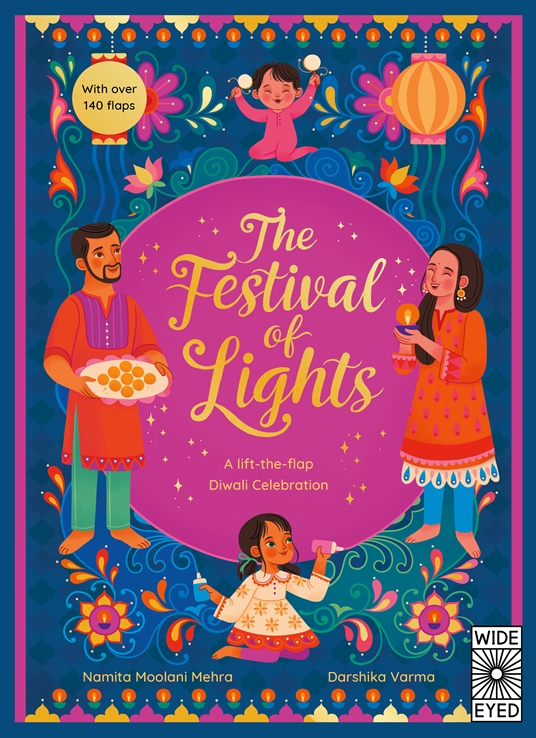 As if Diwali weren’t colorful and fun enough, The Festival of Lights: A Lift-the-flap Diwali Celebration by Namita Moolani Mehra, illustrated by Darshika Varm, makes it even more fun to read about with flaps and things to lift and pull to see more information or details in the illustrations.
The book is a story about a family getting ready for Diwali and what happens on the different days of the five-day celebration. There’s cleaning, shopping, crafting, food preparation and getting the home altar ready for the big day.
It covers decorating the outside of the house with rangoli, diyas and lanterns, buying sweets to share with family and friends, the sights and scents of the mandir (home temple), getting dressed up in new fancy clothes, the story of Diwali and celebrations with relatives.
Flaps (there are more than 140 in all) give you vocabulary words for different foods and definitions, as well as fun things like what’s inside the shopping basket or where the cat is hanging out. They also help illuminate the story of Diwali, which is the triumph of good over evil as Lord Ram defeated the demon Ravana to save his wife, Sita.
This pretty and colorful book helps kids understand what Diwali is and how it is celebrated, regardless of whether they practice it at home. This would be a nice book to keep in a classroom (it’s rated for kids ages 3-7) or to have at home to teach kids about Diwali even if it’s not something you celebrate. Where I live there are a lot of people from India so we are probably exposed to Diwali more than some other regions of America, but it’s a nice holiday to know about wherever you live.
Combine with the book Diwali and check out some fun lantern crafts and printables for kids to round out your experience.
About the book: 24 pages, hardcover, published 2025 by Wide Eyed Editions. Suggested retail prices $22.99.