
This adorable fairy party is full of pastel colors and adorable little bird houses too. Fairy Parties are one of those tried and tested party theme that every little girl loves. Check out all the photos and ideas at Blush Mamas.
Independent craft blog since 2007
This adorable fairy party is full of pastel colors and adorable little bird houses too. Fairy Parties are one of those tried and tested party theme that every little girl loves. Check out all the photos and ideas at Blush Mamas.
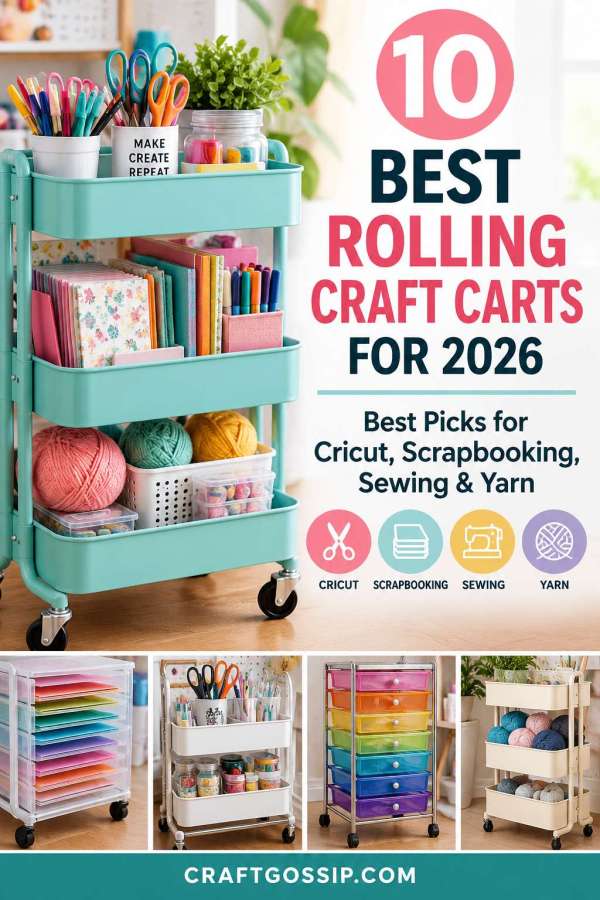
If your craft supplies are slowly taking over the dining table, spare bedroom, sewing desk and possibly one perfectly innocent chair that hasn’t been sat on for six months, a rolling craft cart might be one of the simplest storage fixes you can make.
I love rolling craft carts because they work in real craft spaces.
Not everyone has a dedicated craft room with floor-to-ceiling cabinets and matching storage boxes. Many of us craft at the dining table, sew in a spare bedroom, crochet on the sofa or squeeze a Cricut into whatever patch of desk space happens to be available.
A rolling craft storage cart gives you somewhere to keep the supplies you use most often, then lets you move them out of the way when you are finished.
The trick is choosing the right cart.
A three-tier open cart can be wonderful for yarn and sewing tools but hopeless for hundreds of tiny scrapbook embellishments. A ten-drawer cart may look perfect for paper crafting until you discover that your 12 x 12 cardstock does not actually fit inside it.
And if there is one thing more annoying than craft-room clutter, it is buying storage that doesn’t fit the craft supplies it was supposed to organize.
So I have put together this guide to the best rolling craft carts for 2026, with options for scrapbookers, Cricut users, knitters, crocheters, sewers, quilters and anyone crafting in a small space.
This post may contain affiliate links. If you purchase through one of these links, we may earn a small commission at no additional cost to you.
If you want the short version, these are my favourites by craft and storage style:
Best overall open craft cart: IKEA RÅSKOG Utility Cart
Best rolling cart for a small craft room: Compact IKEA RÅSKOG
Best Amazon craft cart: SUNALLY 3-Tier Rolling Craft Cart
Best Walmart open craft cart: Honey-Can-Do 3-Tier Rolling Craft Cart
Best cart for 12 x 12 scrapbook paper: IRIS 6-Tier Scrapbook Storage Cart at Walmart
Best for lots of small supplies: IRIS 10-Drawer Storage Cart
Best inexpensive metal craft cart: Simply Tidy Lexington 3-Tier Rolling Cart
Best cart for paper scraps and embellishments: Simply Tidy 10-Drawer Rolling Cart
Best for bulkier craft supplies: Simply Tidy 5-Drawer Rolling Cart
Best high-capacity craft cart: Costway 15-Drawer Rolling Storage Cart
Before buying anything, have a look at what you actually need to store.
I recently shared my approach to organizing scrapbook supplies in a small space, and the same rule applies here.
Do not buy storage first and then try to make your supplies fit it.
Sort the stash first.
Then buy the cart.
Otherwise you end up with a very attractive trolley containing six rolls of ribbon, a glue gun, seventeen unrelated pieces of cardstock and that one pair of scissors nobody likes.
The IKEA RÅSKOG Utility Cart has been a craft-room favourite for years, and I can understand why.
There is nothing particularly complicated about it.
Three open tiers. Wheels. Raised sides. Plenty of room to add your own little containers.
And sometimes simple storage is exactly what works best.
The current larger RÅSKOG has three steel tiers and lockable castors, making it particularly useful when you want a cart beside your work area but don’t necessarily want it rolling away every time you reach for the scissors.
I particularly like open rolling carts for supplies you use all the time.
Your top tier could hold scissors, rulers, rotary cutters, glue, crochet hooks or pens.
The second tier could hold whatever project you are currently working on.
Then use the bottom for heavier or bulkier supplies.
The disadvantage is that everything is visible.
If you tend to put things away by throwing them vaguely towards the correct container, an open cart can become a mobile junk pile surprisingly quickly.
Small baskets, jars and cups inside the tiers make a huge difference.
If you love the idea of a RÅSKOG but do not have much floor space, look at the smaller IKEA RÅSKOG Utility Cart.
This compact version is only around 11 inches wide and 15 inches deep, and IKEA specifically positions it as a cart for small spaces.
That makes it a clever option for:
There is also something to be said for deliberately buying a small cart.
Bigger storage has a habit of becoming permission to accumulate more stuff.
Suddenly your lovely new trolley is full and you are looking for another trolley to organize the first trolley.
Ask me how craft rooms happen.
If Amazon is your preferred option, the SUNALLY 3-Tier Rolling Craft Cart is one I would consider for general craft storage.
It has three tiers, wheels and an additional drawer, so you get both open storage and somewhere to hide smaller bits and pieces.
The current Amazon listing identifies it as the SUNALLY 3-Tier Rolling Cart with Drawer, Craft Storage Cart Organizer, and it is also available in several colours and a four-tier version.
This would work particularly well for someone who wants one cart to contain an active project.
For crochet, for example:
Top tier: crochet hooks, scissors, stitch markers and pattern
Drawer: tiny notions you do not want disappearing into the yarn
Middle tier: current yarn
Bottom tier: project bag and extra yarn
For Cricut crafting:
Top tier: weeding tools, scraper, blades and pens
Drawer: spare blades and small accessories
Middle tier: vinyl
Bottom tier: blanks and current project supplies
I like having at least one small enclosed space on an otherwise open trolley. Craft supplies have an uncanny ability to disappear, especially tiny stitch markers and replacement cutting blades.
See the SUNALLY rolling craft cart on Amazon.
Walmart has a particularly nice alternative in the Honey-Can-Do 3-Tier Rolling Craft Cart.
This is another open-shelf design, but this one is specifically marketed as a craft cart rather than just a household utility trolley.
Walmart currently lists three open trays, a grab handle, 360-degree wheels and two locking wheels.
That handle is a small detail that I really like.
If you regularly move your supplies between rooms, being able to grab the trolley properly rather than pulling it by one of the trays is useful.
The open trays make everything easy to see, which is brilliant for supplies that you use frequently.
Just do yourself a favour and add a couple of small containers inside the trays.
Otherwise your tape measure, seam ripper and crochet hooks will inevitably form a tiny craft commune at the bottom.
See the Honey-Can-Do Craft Cart at Walmart.
This is the one I really want scrapbookers to pay attention to.
The IRIS 6-Tier Scrapbook Storage Cart at Walmart is designed specifically around 12 x 12 paper.
Walmart’s current listing states that the six removable cases are designed to accommodate 12 x 12 papers, along with vinyl, tools and art supplies.
That matters.
A lot.
Because one of the easiest mistakes to make when buying a scrapbook storage cart is looking at the overall width of the trolley and assuming your cardstock will fit.
Then it arrives.
You open the drawer.
And your beautiful 12 x 12 paper is half an inch too wide.
There may be language inappropriate for a family craft website at this point.
The IRIS design is also useful because the individual cases can be removed.
That means you could organize them by:
If you scrapbook at a dining table rather than a permanent desk, removable project cases make even more sense.
Pull out the one you need, work on your layout and put it straight back when you are finished.
See the IRIS 12 x 12 Scrapbook Storage Cart at Walmart.
If your scrapbook supplies have already reached the stage where finding the adhesive takes longer than making the page, my small-space scrapbook organization guide will help you sort the stash before you start buying containers.
Sometimes the problem is not large supplies.
It is the hundreds of tiny ones.
Buttons.
Beads.
Stamping supplies.
Sewing notions.
Embroidery floss.
Jewellery findings.
Stickers.
Die cuts.
That is where a drawer cart becomes much more useful than open baskets.
The IRIS 10-Drawer Storage Cart has ten drawers plus divided storage across the top for small accessories.
IRIS currently lists smooth-glide casters, built-in drawer stops and a divided organizer top.
I would use this style for supplies such as:
There is one important warning for scrapbookers.
This particular IRIS 10-drawer cart is not designed for 12 x 12 paper. Even the IRIS product reviews specifically note that letter-size paper fits but 12 x 12 sheets do not.
So if scrapbook paper is your priority, choose the previous IRIS scrapbook cart instead.
For everything small and fiddly, though, ten drawers can be wonderful.
Just resist the urge to create drawer labels so specific that they require their own filing system.
“Buttons” is enough.
You probably do not need “pink buttons smaller than a thumbnail that I might use one day.”
Michaels’ Simply Tidy Lexington 3-Tier Rolling Cart is another good classic utility-cart design.
It is specifically marketed for craft-room organization and comes in a ridiculous number of colours, which I admit is more tempting than it should be.
Michaels lists three mesh trays, two locking wheels and a maximum load of 6.6 lb per tray.
This makes it especially suitable for lighter everyday supplies.
For a scrapbooker:
Top: adhesives, scissors, ruler, pens
Middle: current project
Bottom: punches and paper tools
For knitting or crochet:
Top: hooks, needles, scissors and notions
Middle: current project
Bottom: extra yarn
For sewing:
Top: scissors, rotary cutter, clips and seam ripper
Middle: current sewing project
Bottom: interfacing, notions and fabric
One thing I particularly like about this type of cart is that it can become a working cart, rather than permanent storage.
That distinction matters.
Permanent storage holds your entire stash.
A working cart holds what you need right now.
That is often much more useful.
If yarn is threatening to take over your storage before it even reaches the cart, I have also put together these ideas for sorting and organizing your yarn stash.
The Simply Tidy 10-Drawer Rolling Cart is a better choice when you want lots of shallow categories.
Ten drawers can be incredibly useful for:
Michaels still carries this as part of its current rolling storage-cart range.
Again, though, I would not buy this one specifically for 12 x 12 scrapbook paper.
That is exactly why the IRIS 12 x 12 option earned its own place higher up this list.
A ten-drawer cart works best when you use fairly broad categories.
Try:
Drawer 1: adhesives
Drawer 2: stickers
Drawer 3: stamps
Drawer 4: dies
Drawer 5: scraps
Drawer 6: tools
You get the idea.
If you reach Drawer 10 and discover you have created a category called “miscellaneous miscellaneous,” it may be time for a small declutter.
The Simply Tidy 5-Drawer Rolling Cart gives you fewer drawers, but that can actually be better depending on what you make.
Michaels currently carries both five-drawer and ten-drawer Simply Tidy configurations.
I would choose fewer, roomier drawers for supplies like:
It can also work brilliantly as a work-in-progress cart.
Give each active craft project its own drawer.
Now, I realize we are technically meant to finish one craft project before starting another.
I am also aware that unicorns are lovely.
In the real world, many of us have several projects going at once.
A separate drawer for each one means you can stop halfway through without leaving everything spread across the table.
That alone can make a craft cart worth having.
And then there are those of us who look at ten drawers and think:
“But where does the rest of it go?”
The Costway 15-Drawer Rolling Storage Cart is the big-capacity option.
The current Costway model has fifteen drawers and comes in multiple colour combinations.
This sort of cart makes sense if you move between several crafts.
You could divide it into zones:
Drawers 1 to 3: sewing
Drawers 4 to 6: scrapbooking
Drawers 7 to 9: Cricut supplies
Drawers 10 to 12: painting
Drawers 13 to 15: current projects
I also like mixed drawer sizes because craft supplies are not conveniently shaped.
A spool of thread and an embroidery hoop clearly did not consult each other before deciding how much space they required.
The only caution with a big drawer cart is that more drawers do not automatically mean more organization.
Fifteen drawers labelled “stuff” are still a junk cupboard.
It just has wheels now.
For scrapbookers, I would prioritize paper dimensions before anything else.
If your main concern is storing 12 x 12 cardstock and scrapbook paper, the IRIS 6-Tier Scrapbook Cart at Walmart is the strongest option on this list because its cases are specifically designed for that size.
If your paper already has a separate storage system and you mainly need somewhere for:
then a ten-drawer cart becomes much more useful.
For a small scrapbook space, I would ideally have:
The goal is not necessarily to get every scrapbook supply you own into the trolley.
The goal is to make it easy to sit down and start crafting.
For knitting and crochet, I generally prefer open carts.
Yarn is bulky.
It is soft.
It is awkward.
And somehow one ball of yarn can occupy three times the amount of space it appeared to occupy in the shop.
An open three-tier cart such as the IKEA RÅSKOG, SUNALLY Amazon cart or Honey-Can-Do Walmart cart works beautifully as a project station.
Use cups or little baskets for:
Then put the actual yarn and work in progress into the larger tiers.
I would not try to put your entire yarn stash into the trolley unless your yarn stash consists of twelve very disciplined balls.
Use the cart for active projects and keep long-term yarn storage elsewhere.
Sewing supplies fall somewhere between large and tiny, which means either an open cart or a mixed drawer cart can work.
An open top tray is perfect for things you constantly reach for:
Drawers are better for:
And keep your heavier supplies down low.
Michaels gives the same advice for its Lexington carts because placing heavier items in the lower tray helps reduce the risk of tipping.
If buying another storage unit is not particularly appealing, there are also some surprisingly useful ideas in these 15 upcycled craft storage projects.
Some of my favourite craft organizers started life as something destined for the recycling bin.
Rolling carts and Cricut accessories are a very happy combination.
Cricut supplies spread.
First there is the machine.
Then the vinyl.
Then the transfer tape.
Then the mats.
Then the pens.
Then the tools.
Then the blanks.
Then somehow you own vinyl in seventeen colours and still do not have the exact green you need.
A three-tier cart works particularly well for:
Top: weeding tools, scraper, scissors, blades and pens
Middle: vinyl and transfer tape
Bottom: blanks, mats and current projects
I would be more cautious about automatically putting your actual Cricut machine on top of a lightweight utility trolley.
Check the cart dimensions, stability and manufacturer weight recommendations first.
The machine moves while cutting, and this is not somewhere I would improvise.
If vinyl rolls are the particular problem, CraftBits has a simple DIY Cricut vinyl roll holder that lets you use vertical storage rather than sacrificing an entire cart shelf.
This really comes down to what you make.
The advantage is visibility.
You can see what you own and grab it quickly.
The advantage is separation.
Tiny items stay contained rather than slowly migrating into one giant crafty soup.
If you work with 12 x 12 paper or like taking individual projects to another table, a case-based scrapbook cart makes a lot of sense.
This is the boring bit that saves you from buying the wrong cart.
Especially paper.
Do not just measure the space where the trolley will go.
Measure what needs to go inside it.
The external cart width tells you almost nothing about whether 12 x 12 paper fits.
Always look for internal measurements.
If you are pulling open drawers, cutting, drawing or using the cart beside your work table, locking wheels are incredibly useful.
Tiny casters behave very differently on thick carpet than on tiles or timber floors.
If your craft room is carpeted, wheel size deserves a little more attention.
Paper is heavy.
Fabric is heavy.
Paint is heavy.
Craft supplies have an impressive ability to look innocent until you try to lift the box.
Do not automatically assume that because a machine physically fits on a trolley, the trolley is designed to carry it.
Lots of shallow drawers are brilliant for embellishments.
They are dreadful for a large cake of yarn.
Buy for your craft, not for how pretty the trolley looks online.
Measure the space where the trolley goes when you are not crafting.
This is especially important in shared rooms.
The whole point of a rolling cart is that it can disappear somewhere sensible when you are finished.
This one is surprisingly difficult.
Do not fill every drawer and tray the day the trolley arrives.
Leave somewhere for the current project.
If the new storage is already overflowing before you use it, you have not solved the storage problem.
You have simply put wheels underneath it.
The first day is easy.
Everything is beautifully sorted.
The scissors have a home.
The yarn is arranged nicely.
Nothing is spilling over.
Then real life begins.
A week later there is a coffee cup on the top, three random receipts, a charger, some ribbon and something nobody in the family is willing to claim.
So here is the system I find more realistic.
Make it your:
A trolley that is responsible for every craft you have ever attempted is going to struggle.
The supplies you reach for constantly deserve prime position.
Scissors.
Glue.
Hooks.
Pens.
Rotary cutter.
Whatever you use every session.
This makes the trolley more stable and usually easier to move.
Yes, we have reached the point where we are buying storage for the storage.
But it works.
Cups, jars, divided organizers and small baskets prevent open tiers from becoming chaotic.
Before buying lots of new containers, have a look at these DIY storage and organization ideas on CraftBits. You may already have something around the house that can do the job.
This might be the most useful thing you do.
If everything you need for your current project is together, sitting down to craft becomes easy.
No searching.
No unpacking five boxes.
No discovering that the scissors have wandered off again.
That gorgeous pink trolley is not going to become any less gorgeous when your paper does not fit.
Measure first.
Open carts need small organizers inside them if you are storing beads, buttons, embellishments or notions.
Check weight and size recommendations.
Do not turn your expensive craft machine into a trolley stability experiment.
You need some breathing room.
Otherwise you have to remove four things every time you want the fifth thing.
Rolling carts are most useful when they contain supplies you actually use.
They are less useful when they become retirement villages for abandoned craft projects.
And yes, I am aware that several of my own unfinished projects would like a word.
Yes. They are particularly useful in small craft rooms and shared spaces because they provide vertical storage without requiring permanent built-in shelving.
A compact cart can also be rolled under or beside a desk when you are finished crafting.
For standard 12 x 12 scrapbook paper, choose a cart specifically designed to fit 12 x 12 sheets.
The IRIS 6-Tier Scrapbook Storage Cart at Walmart is designed for 12 x 12 paper.
Do not assume ordinary ten-drawer craft carts will fit scrapbook paper.
Many do not.
Neither is universally better.
A three-tier cart is better for bulky or frequently used supplies such as yarn, paint, Cricut accessories and works in progress.
Drawer carts are better for small supplies such as stickers, dies, beads, notions and embellishments.
Keep the tools you use most frequently at the top.
This might include scissors, glue, pens, crochet hooks, rulers, sewing clips or Cricut tools.
Absolutely.
Three-tier rolling carts make excellent knitting and crochet project stations.
Use the trolley for current projects rather than trying to store your entire yarn stash on it.
Possibly, but check the trolley’s dimensions, weight capacity and stability first.
Lightweight utility carts are often better used for Cricut accessories, vinyl and tools rather than as the permanent cutting-machine surface.
I strongly prefer them.
Locking wheels make the trolley more stable when opening drawers or reaching for supplies.
It depends on what you are storing.
Metal open carts are great for general supplies and current projects.
Plastic drawer carts are useful for separating lots of small items.
The best rolling craft cart is the one designed around what you actually make.
If I wanted one versatile cart for everyday crafting, I would choose a three-tier open trolley.
The IKEA RÅSKOG, SUNALLY cart on Amazon and Honey-Can-Do cart at Walmart all fit that role.
If I were primarily a scrapbooker, I would skip the generic drawer carts and choose the IRIS 12 x 12 Scrapbook Storage Cart.
If my problem were buttons, stamps, dies, beads or sewing notions, I would go straight to drawers.
And if my craft stash had already reached the point where fifteen drawers sounded completely reasonable?
Well.
At that point I am not here to judge you.
I am probably standing beside you wondering whether it comes in pink.
The best craft storage does not need to make your room look like a magazine.
It needs to make you want to sit down and actually create.
If you can roll the cart beside your chair, find what you need without digging through six boxes, and put everything away again when you are finished, then it is doing exactly what good craft storage should do.