I’ll admit, I have never heard of a Rotozip spiral saw before, but that’s what Lucy from Lucy’s Designs used to create these cool pumpkin designs. I love the swirls!
Head over to Lucy’s Designs for a little rotozipped pumpkin inspiration.
Independent craft blog since 2007
I’ll admit, I have never heard of a Rotozip spiral saw before, but that’s what Lucy from Lucy’s Designs used to create these cool pumpkin designs. I love the swirls!
Head over to Lucy’s Designs for a little rotozipped pumpkin inspiration.
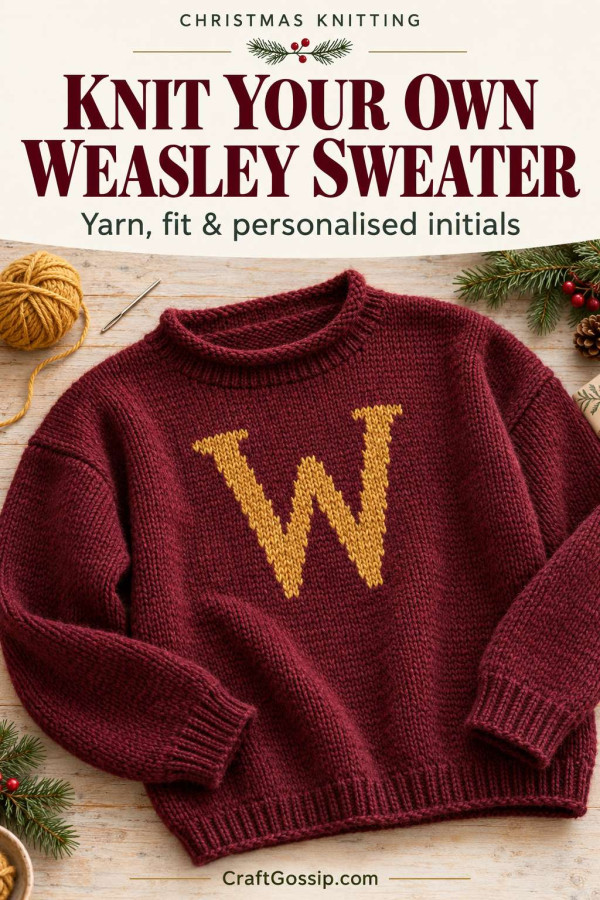
There are Christmas jumpers you wear for a laugh, and then there are Christmas jumpers you would quite happily keep on until February. A roomy knitted sweater with a big initial on the front falls firmly into the second category.
The Weasley-inspired version has that lovely homemade appeal: simple knitting, a comfortable shape and a letter that makes it feel as though somebody knitted it especially for you. Which, of course, is rather the point.
If you’ve been searching for a Weasley sweater knitting pattern, the tutorial from Kneedles & Life is worth a look. But before you buy a sweater’s worth of yarn, there is an important distinction: it is an adaptation guide, rather than a complete standalone garment pattern.
Here is my review of the approach, along with the practical details I would work through before casting on.
This is an editorial review of the published tutorial and linked pattern information. I have not knitted a sample from this adaptation.
Kalley’s Weasley Christmas sweater tutorial explains how she adapted existing sweater patterns, selected yarn and added personalised letters using duplicate stitch.
It also describes creating a letter chart with Stitch Fiddle and adjusting the appearance of rolled edges through finishing.
The useful thing about this approach is its flexibility. You can choose a suitable sweater foundation and personalise it, rather than needing a separate design for every initial.
However, you will still need a complete base pattern for garment sizing, shaping, gauge and yarn requirements. The post does not provide a graded family sweater pattern or a ready-made alphabet chart collection.
What appeals to me most is the separation between knitting the garment and adding the decoration.
A whole sweater can feel like quite enough commitment without also worrying about whether a large letter is landing in the right place. Adding the initial afterwards lets you concentrate on the fit first.
My main reservation is beginner expectation. A confident knitter may see an adaptable project; somebody making their first jumper may expect all the instructions in one place.
I would recommend this tutorial to knitters who are comfortable following a sweater pattern and want help developing the personalised look. For a first garment, choose a well-supported base pattern and keep its construction instructions close at hand.
Look for a plain stocking-stitch front with enough uninterrupted space for your initial. Heavy texture, cables or a busy colour pattern will compete with the lettering.
Check these details before purchasing:
The Homebody Sweater by Justyna Srock, used as a foundation in the tutorial, is worked from the bottom up, with upper panels worked flat and shoulders seamed. It is therefore worth checking the construction carefully if avoiding seams is important to you.
Another option mentioned is Roll With Me by Autumn Becker. Its women’s version features a boxy fit and rolled neckline, with approximately 4–5 inches of positive ease.
Choose by finished measurements rather than the size label alone. Two patterns marked “medium” can produce very different jumpers.
If you would rather explore a published Harry Potter knitting collection, our review of Harry Potter Knitting Magic is another useful starting point.
My first question would be: will the person receiving this actually enjoy wearing it?
A beautifully rustic yarn can look perfect and still feel uncomfortable against someone’s neck. That matters rather more than how convincing it looks in a Christmas photograph.
For your own version, consider:
Wool: A good option for warmth and a traditional appearance. Check softness and washing requirements.
Wool blends: Useful when you want some wool character with different care or comfort qualities. Read the individual label.
Acrylic: Worth considering for someone who avoids wool or needs straightforward care. Swatch to check the fabric and drape.
Superwash wool: Can suit gifts, but follow the specific washing instructions and check how the washed swatch behaves.
For the initial, choose a smooth contrasting yarn close to the thickness of your main yarn. A much heavier yarn can make the letter bulky; a very fine one may leave the background showing through.
If you are comparing yarn at Mary Maxim or another yarn supplier, look at metres per ball, fibre content and the pattern’s required gauge. Ball weight alone will not tell you whether a substitute is suitable.
Use the yardage or metre requirements in your selected base pattern for your size. Allow separately for swatching, the initial and any changes to body or sleeve length.
To calculate balls required:
Required metres ÷ metres per ball = number of balls, rounded up.
For example, a pattern requiring 1,200 metres needs six balls of yarn containing 200 metres each. That calculation covers the stated requirement; additional length or a separate swatch may require more.
I know. Swatching is rarely the exciting bit.
But a personalised sweater involves both fit and lettering proportions, so the swatch has two jobs.
Make it large enough to measure away from the edges, using the method specified by your pattern. Wash and dry it as you intend to care for the sweater, then measure the stitch and row gauge.
Next, practise a small section of duplicate stitch on it. Check whether:
It is much nicer to discover an unsuitable contrast yarn on a swatch than halfway through an enormous gold initial.
A letter that looks balanced on a chart can look surprisingly different on a curved, wearable garment.
Start by marking the intended position on the sweater with removable markers or loose basting threads. Check it on the wearer, or against a favourite jumper of similar fit.
Then use your actual gauge to calculate the chart area.
For example, at 18 stitches and 24 rows per 10 cm, a letter measuring 15 cm wide and 20 cm high would occupy:
These are example figures, not a gauge recommendation for the project.
Knitted stitches are usually wider than they are tall. Use knitting graph proportions when judging the design, because ordinary square graph paper can give a misleading preview.
A charting tool such as Stitch Fiddle can help, but inspect the result before stitching. Remove stray colour cells and check that the letter is recognisable at its intended size.
Duplicate stitch follows the shape of existing knitted stitches, covering them with another colour.
For this project, my priorities would be even tension and a flexible fabric:
Pause occasionally and lay the work flat. If the initial starts gathering the sweater fabric, loosen the affected stitches before continuing.
For a child’s jumper, choose a properly sized child’s base pattern. Reducing an adult garment by guesswork can leave you with awkward armholes or a neckline that is difficult to pull over a head.
Stocking stitch naturally curls. That can be part of the relaxed look, but the amount of curl depends on the yarn, gauge and finishing.
If you remove ribbing from a base pattern, you are changing how that edge behaves. You may also change the usable garment length once the hem rolls.
Test your preferred edge on a swatch before adapting the whole sweater. Block according to the yarn’s care instructions, and remember that blocking does not permanently remove stocking stitch’s tendency to curl.
If a stable hem matters more to you than matching a particular appearance, keeping the original ribbing is a perfectly sensible choice.
Yes, provided the recipient likes the style and you leave enough time.
A personalised jumper involves measuring, swatching, garment knitting, finishing and lettering. A family set multiplies all of those jobs rather quickly.
I would make one first, record the changes and assess the result before committing to several.
If the calendar is already looking unreasonable, a smaller themed project may be more enjoyable. Our Hogwarts-inspired knitting and crochet ideas offer another direction, while this tiny knitted Christmas sweater ornament provides miniature jumper inspiration.
There is no shame in scaling down the gift. The yarn basket is already full of ambitious promises.
The article is free to read, but it is an adaptation guide. You need a separate base sweater pattern for the full garment instructions.
No. Duplicate stitch lets you add an initial after knitting the garment. Practise on a swatch first to check coverage and tension.
A newer knitter can work towards one, but the difficulty depends on the base pattern. Choose clear instructions, check the required techniques and practise the lettering separately.
Potentially, if the knitted stitches are clear enough to follow. Test a discreet area first and choose a contrast yarn compatible with the fabric and washing requirements.
I would recommend it as inspiration and an adaptation guide for knitters who already have, or are ready to choose, a suitable sweater pattern.
The personalised initial is the part that gives the project its heart. My advice is to put just as much thought into softness, fit and washing as you put into that big letter.
Start with a jumper the recipient will love wearing, then add the little touch of Christmas magic.